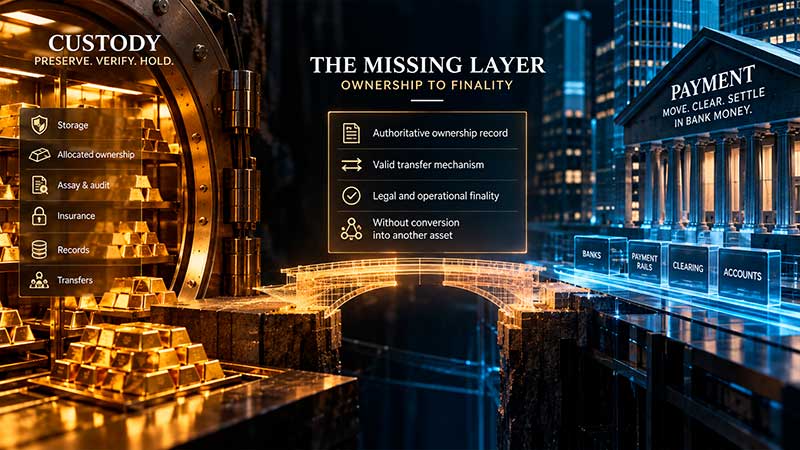
Gold Has a Settlement Problem. Not a Storage Problem.
Gold has spent decades being modernised around the edges.
It can be vaulted securely.
It can be allocated to specific owners.
It can be assayed, audited, insured and reconciled.
It can be priced globally.
It can be traded electronically.
It can be financed, hedged and delivered through sophisticated institutional infrastructure.
What it still does remarkably poorly is something much simpler:
settle an obligation directly.
The problem is not that gold cannot be stored.
The problem is that the infrastructure surrounding gold was largely built to preserve, verify, price and trade it, not to make ownership itself operational at the moment of settlement.
An asset can therefore be perfectly stored and still remain outside the settlement process.
Gold custody is already highly developed
Physical gold is not an immature asset class waiting for basic infrastructure.
The industry already knows how to answer the obvious questions.
Where is the metal?
Who holds it?
What is its purity?
Which bars are allocated?
Who owns them?
How are they insured?
How can they be delivered or sold?
For institutional participants, custody arrangements can be extremely precise.
Bars can be identified.
Ownership can be recorded.
Inventory can be verified.
Transfers and withdrawals can be documented.
But custody developed primarily to solve a different problem: preserving the asset and establishing reliable evidence of rights over it.
Settlement asks something else.
It asks how those rights can be used to discharge an obligation between parties.
That has historically not been the primary function of gold custody infrastructure.
The physical layer is mature.
The settlement layer is not.
Storage and settlement solve different problems
Storage answers:
Where is the asset and who is entitled to it?
Settlement asks:
Can that asset discharge an obligation directly?
Those are different functions, and conflating them is part of the problem.
A vault can protect an asset for decades without giving the owner a practical mechanism to settle a transaction with it.
Custody can establish ownership without providing a direct settlement path.
The distinction becomes visible the moment an owner wants to use the metal.
In most conventional arrangements, the sequence is familiar.
Gold is held.
A transaction needs to be funded.
Some or all of the gold is sold.
Bank money is credited.
That money then moves through conventional payment infrastructure.
The commercial obligation is discharged in bank money.
Gold supplied the value.
Gold did not perform the settlement.
The asset left its own architecture before the obligation was discharged.
Liquidity is not settlement, and conversion is not use
Gold is often described as highly liquid.
That is true.
There are deep markets in which it can be bought and sold.
But liquidity answers:
How easily can the asset be converted?
Settlement asks:
Can the asset itself complete the obligation?
Those questions are not equivalent.
A highly liquid asset may still require conversion before it can be used operationally.
Indeed, the existence of deep liquidity can hide the absence of direct settlement infrastructure because conversion works well enough that the underlying problem rarely has to be confronted.
Sell the gold.
Receive cash.
Use the cash.
Operationally, the process works.
Architecturally, however, the settlement asset has changed.
Once gold becomes bank money, settlement depends on the infrastructure of bank money: accounts, banks, payment rails, clearing arrangements and the institutions operating them.
Conversion therefore proves something narrower than direct usability.
It proves that the asset can be replaced by something else.
If gold must first be sold before an obligation can be discharged, then gold is not the settlement asset.
It is the funding asset.
Those roles should not be confused.
Digital access has improved faster than settlement
Gold has become much easier to access digitally.
An owner may see holdings through an application.
Instructions may be transmitted electronically.
Positions may be updated quickly.
Transfers between accounts may be automated.
All of this reduces friction.
But digital control does not, by itself, create settlement.
A better interface can make gold easier to buy, sell, view or instruct without changing the underlying settlement model at all.
The decisive question remains:
When one party transfers gold to another, at what point has ownership changed with sufficient authority and finality to discharge the obligation between them?
That is not primarily an interface problem.
It is an architectural one.
The screen can become modern while the settlement model remains conventional.
The metal does not need to move
Direct settlement in physical gold does not require physical delivery for every transaction.
Physical movement and ownership movement are separate events.
A bar may remain in the same vault while the rights attached to it move from one owner to another.
The physical asset does not have to travel.
The ownership does.
This distinction changes the problem completely.
The settlement architecture must separate four things:
the physical location of the asset;
the authoritative record of ownership;
the valid instruction to transfer;
and the point at which that transfer becomes final.
Once those layers are separated, physical gold no longer looks like an object that must be transported every time it is used.
It becomes a physical settlement asset whose ownership can change while the metal remains in custody.
The missing layer is between custody and payment
Gold infrastructure already has custody.
Financial infrastructure already has payment.
What remains underdeveloped is the layer connecting ownership of the physical asset to final discharge of an obligation.
That layer must answer questions neither a vault nor a payment processor can answer alone.
Which gold is available for settlement?
Who has authority to transfer it?
What quantity or ownership interest is being transferred?
Which record defines the pre-settlement position?
Which record defines the post-settlement position?
At what point does the recipient acquire the relevant ownership right?
Can the transfer be reversed?
What dependencies remain after the transfer is registered?
And does any external system still have to act before the obligation is discharged?
These questions define the settlement function.
Functionally, the missing layer must connect three things:
an authoritative ownership position;
a valid mechanism for changing that position;
and a rule under which that change becomes final enough to discharge the obligation.
Crucially, it must do so without requiring the asset to be converted into another settlement medium first.
That is the difference between digitising access to gold and creating settlement architecture around gold.
Allocated ownership solves one problem, not all of them
Allocated physical gold provides an important starting point because the ownership structure can refer to identifiable physical assets rather than an undifferentiated unsecured claim.
That removes one class of uncertainty.
It helps answer:
What is the object of the ownership right?
But it does not answer:
How does that right move from one participant to another in settlement?
Allocated custody still requires custody arrangements, authoritative records, valid instructions and legal rules governing ownership.
It does not eliminate infrastructure.
Nor should it.
What it does is establish a clearer asset and ownership position before the settlement event.
The next problem is different.
The architecture must define how that position changes, who can authorise the change, which record governs it and when the resulting ownership position becomes final.
Allocated custody therefore solves part of the ownership problem.
It does not, by itself, solve the settlement problem.
Settlement architecture is not monetary policy
Direct settlement in gold does not require an argument that all economic activity should move to gold.
That is a different debate.
Settlement architecture is not monetary policy.
The question is not what money should be.
The question is whether an asset can discharge an obligation directly when the parties already hold and recognise that asset.
Bank money is highly efficient for many purposes.
Businesses require credit, liquidity and working capital.
Securities operate through their own settlement infrastructures.
None of this is challenged by asking a narrower architectural question:
Where parties already hold physical gold, when does it make sense to settle directly in that asset rather than repeatedly converting through another settlement medium?
That question does not require a prediction about gold prices.
It does not require a return to a historical gold standard.
It does not require opposition to banking.
It asks only whether conversion performs a necessary economic function or compensates for the absence of a direct settlement mechanism.
The current architecture creates a round trip
Consider two participants who both hold allocated physical gold.
One owes value to the other.
If the first participant must sell gold for bank money, send the bank money through conventional payment infrastructure, and the second participant later uses that money to acquire gold again, the sequence becomes:
Gold
Bank money
Payment infrastructure
Bank money
Gold
There may be legitimate reasons for doing this.
But the sequence is not an inevitable property of the asset.
It is a consequence of the architecture available around it.
The relevant question is whether the intermediate conversion contributes something economically necessary.
If it does, the round trip has a purpose.
If it exists only because ownership of the original asset cannot itself be transferred with sufficient finality, then the inefficiency lies elsewhere.
Not in the gold.
In the settlement architecture around it.
Gold’s weakness is not physical
Gold is often criticised for being physically cumbersome.
That criticism misses the more interesting problem.
Its physical existence is not the weakness.
It is precisely what distinguishes gold from an institutional liability or a purely digital representation.
The architectural weakness is the distance between ownership and operational settlement.
The metal sits in one system.
Payments occur in another.
Conversion connects them.
That arrangement works.
But it should not be mistaken for the only possible architecture.
The alternative is not to pretend the physical asset is digital.
It is not to make custody disappear.
And it is not necessarily to replace ownership with another representation of ownership.
The more interesting possibility is simpler:
make the authoritative change of ownership the settlement event itself.
The problem has been misidentified
Gold does not lack storage.
It does not lack markets.
It does not lack sophisticated custody.
It does not lack liquidity.
It does not even lack digital interfaces.
What remains underdeveloped is an architecture in which ownership of allocated physical metal can change with sufficient operational and legal finality to discharge an obligation without first becoming another asset.
That is not primarily a storage problem.
It is not primarily a payment-interface problem.
It is a settlement problem.
And once the problem is stated correctly, the design question changes.
Not:
How do we make gold easier to store?
Not:
How do we make gold easier to spend?
But:
How do we make a change in gold ownership become the final settlement event?
Gold does not need another way to sit in a vault.
It needs a clearer path from ownership to finality.
Petro Golovko Sc.D., Ph.D.
Invisible Architecture Press