Gold Has a Settlement Problem. Not a Storage Problem.
Gold has spent decades being modernised around the edges.
It can be vaulted securely.
It can be allocated to specific owners.
It can be assayed, audited, insured and reconciled.
It can be priced globally.
It can be traded electronically.
It can be financed, hedged and delivered through sophisticated institutional infrastructure.
The gold market also has established clearing and settlement arrangements. The London bullion market, for example, processes substantial volumes of transactions through unallocated precious-metal accounts.
But those arrangements reveal a distinction that deserves much greater attention.
Settlement through a contractual claim to gold is not the same legal event as settlement through the transfer of ownership of identified physical bullion.
What remains comparatively underdeveloped is something more specific:
A routine institutional mechanism through which the legally effective transfer of ownership of physical gold directly discharges a commercial obligation.
The problem is not that gold cannot be stored.
Nor is it that gold cannot already be used in settlement.
The problem is that much of the infrastructure surrounding physical gold was developed to preserve, verify, price, trade and finance it, rather than to make proprietary ownership itself operational as a direct settlement mechanism.
An asset can therefore be perfectly stored, legally owned and commercially valuable while still lacking a practical route to settle an unrelated obligation through the transfer of its ownership.
Gold custody is already highly developed
Physical gold is not an immature asset class waiting for basic infrastructure.
The industry already knows how to answer the obvious questions.
Where is the metal?
Who holds it?
What is its purity?
Which bars are allocated?
Who owns them?
How are they insured?
How can they be delivered or sold?
For institutional participants, custody arrangements can be extremely precise.
Bars can be identified.
Ownership can be recorded.
Inventory can be verified.
Transfers and withdrawals can be documented.
But custody developed primarily to solve a different problem: preserving an asset and establishing reliable evidence of the rights associated with it.
Settlement asks something else.
It asks how those rights can be used to discharge an obligation between parties.
That has not historically been the primary function of conventional allocated gold custody infrastructure.
The physical layer is mature.
The integration of proprietary ownership with legally effective commercial settlement remains less developed.
Storage and settlement solve different problems
Storage answers:
Where is the asset, and who is entitled to it?
Settlement asks:
Can the transfer of that asset, or of a legally recognised right associated with it, discharge an obligation?
Those are different functions, and conflating them is part of the problem.
A vault can protect an asset for decades without giving its owner a practical mechanism for settling transactions directly through a transfer of title.
Custody can establish an ownership position without independently providing a complete settlement mechanism.
The distinction becomes visible the moment an owner wants to use the metal.
In a conventional commercial arrangement, the sequence may be familiar.
Gold is held.
A transaction needs to be funded.
Some or all of the gold is sold.
Bank money is credited.
That money moves through conventional payment infrastructure.
The commercial obligation is discharged through the agreed monetary settlement mechanism.
Gold supplied the value.
Gold did not itself perform that settlement.
The asset was converted into another settlement medium before the obligation was discharged.
This is a legitimate and often efficient process.
But it is not direct proprietary settlement in physical gold.
Liquidity is not settlement, and conversion is not use
Gold is often described as highly liquid.
That is true.
There are deep markets in which it can be bought and sold.
But liquidity answers:
How easily can the asset be converted?
Settlement asks:
Can the asset, or the relevant right associated with it, complete the obligation?
Those questions are not equivalent.
A highly liquid asset may still require conversion before it can be used in a particular commercial transaction.
Indeed, the existence of deep liquidity can conceal the absence of more direct settlement mechanisms.
Conversion works sufficiently well that the underlying architectural question rarely needs to be confronted.
Sell the gold.
Receive bank money.
Use the bank money.
Operationally, the process works.
Architecturally, however, the settlement asset has changed.
Once gold has been converted into bank money, the transaction depends on the institutional structure governing that money: accounts, banks, payment systems, clearing arrangements and the relevant settlement rules.
Conversion therefore proves something narrower than direct usability.
It proves that the asset can be exchanged for something else.
If gold must first be sold before a particular obligation can be discharged, gold is functioning as the funding asset rather than as the asset transferred in settlement.
Those roles should not be confused.
The distinction becomes even more important when gold is represented by an unallocated account.
The London Bullion Market Association expressly distinguishes unallocated metal accounts, which ordinarily create contractual claims against account providers, from allocated accounts identifying specific physical bars.
Both arrangements serve legitimate commercial purposes.
Both can support transactions.
But a credit in an unallocated account does not automatically confer ownership of identified bullion.
The legal character of the right being transferred matters as much as the economic value it represents.
Digital access has improved faster than proprietary settlement
Gold has become much easier to access digitally.
An owner may see holdings through an application.
Instructions may be transmitted electronically.
Positions may be updated quickly.
Transfers between accounts may be automated.
All of this reduces friction.
But digital control does not, by itself, establish a legally effective proprietary transfer or the discharge of a commercial obligation.
A better interface can make gold easier to buy, sell, view or instruct without changing the underlying legal structure.
A record may confirm that an instruction has been accepted.
Another may show that an account balance has changed.
A third may indicate that a custody position has been updated.
None of those events should automatically be confused with every legal consequence that a completed settlement requires.
The decisive questions remain:
What right has been transferred?
When did that transfer become legally effective?
Has the underlying obligation been discharged?
A technical record may provide evidence of these events.
Its accuracy is valuable.
But the legal significance of the record depends on the applicable law, the governing agreements and the actual mechanism of transfer.
This is not primarily an interface problem.
It is an architectural one.
The screen can become modern while the legal settlement model remains unchanged.
The metal does not need to move
Direct settlement in physical gold does not necessarily require physical delivery for every transaction.
Physical movement and ownership transfer are distinct events.
A particular bar may remain in the same vault while the rights attached to it pass from one owner to another.
The physical asset does not have to travel.
The ownership does have to change effectively under the applicable legal arrangements.
But a transfer of ownership is only one part of the intended settlement result.
The parties must also establish that the transfer constitutes the agreed performance of the underlying commercial obligation.
Proprietary transfer and contractual discharge are distinct legal events.
They must be connected by an effective legal mechanism.
Consider a simple example.
Party A owes Party B €2 million.
Party A owns identified physical gold held under an allocated custody arrangement.
Both parties agree that the obligation may be discharged through the transfer of ownership of specified bullion at an agreed valuation.
The gold remains in the vault.
Party A gives the necessary instruction.
The custodian updates its records.
But three separate matters must be established.
First, Party A must possess the rights and authority necessary to transfer the identified gold.
Second, the required acts must effect a valid transfer of the relevant proprietary right to Party B.
Third, the parties’ agreement and applicable law must give that transfer the intended effect of discharging the €2 million obligation.
A completed account entry may evidence the transaction.
It does not necessarily establish all three matters by itself.
A settlement architecture must demonstrate both the legally effective transfer of ownership and the discharge of the underlying obligation.
This distinction changes the problem completely.
The architecture must separate at least five things:
The physical identity and location of the asset.
The legally recognised ownership position before settlement.
The authority and mechanism required to transfer that position.
The point at which the proprietary transfer becomes legally effective.
The contractual and legal conditions under which the underlying obligation is discharged.
Once these functions are properly connected, physical gold no longer has to be treated as an object that must be transported whenever its value is used.
It becomes a physical settlement asset whose ownership may change while the metal remains in custody.
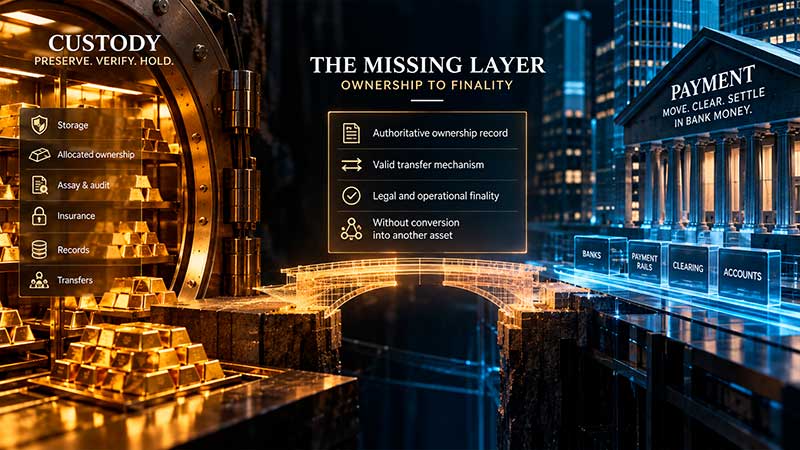
The missing layer is between custody and payment
Gold infrastructure already has custody.
Financial infrastructure already has payment.
Existing bullion markets also have established methods of clearing and settling gold-related obligations.
What remains comparatively underdeveloped is a broadly usable institutional layer connecting the ownership of identified physical gold directly to the final discharge of a commercial obligation.
That layer must answer questions neither a vault nor a payment processor can answer alone.
Which gold is available for settlement?
Who has authority to transfer it?
What quantity or ownership interest is being transferred?
Which record establishes the pre-settlement ownership position?
Which acts are legally necessary to transfer that ownership?
Who confirms their completion?
At what point does the recipient acquire the intended proprietary right?
Under what conditions is the underlying obligation discharged?
Can the transfer be reversed or challenged under applicable law?
What dependencies remain after the transfer is registered?
And does any external institution still have to perform an additional act before the obligation is finally satisfied?
These questions define the architecture of direct proprietary settlement.
Functionally, the missing layer must connect three fundamental components:
An authoritative and legally supportable ownership position.
A valid mechanism for transferring the relevant proprietary right.
A legally effective rule connecting that transfer to the discharge of the underlying obligation.
It must also make those events sufficiently identifiable and evidentially reliable to withstand disputes and operational failures.
Crucially, it should be capable of performing this function without requiring the asset to be converted into another settlement medium first.
That is the difference between digitising access to gold and creating settlement architecture around ownership of physical gold.
Allocated ownership solves one problem, not all of them
Allocated physical gold provides an important starting point.
Under a properly established allocated custody arrangement, the ownership structure can refer to identifiable physical assets rather than merely to an undifferentiated contractual claim against an account provider.
That distinction changes the legal and credit-risk position of the holder.
It helps answer:
What is the object of the ownership right?
But it does not automatically answer:
How does that right pass from one participant to another in settlement?
Allocated custody still requires custody arrangements, authoritative records, valid instructions and legal rules governing proprietary rights.
Nor does ownership necessarily imply unrestricted operational control.
A custodian may operate under agreed withdrawal procedures.
The relevant metal may be subject to security interests, lawful restrictions or competing claims.
A transfer may depend on specific legal and contractual conditions.
These dependencies do not make ownership meaningless.
They demonstrate why ownership and the ability to exercise ownership must be examined separately.
Allocated custody does not eliminate infrastructure.
Nor should it.
What it can provide is a clearer asset and ownership position before the settlement event.
The next problem is different.
The architecture must establish how that position changes, who can authorise the change, which legal acts make it effective and how the resulting transfer discharges the relevant obligation.
Allocated custody can establish the proprietary starting point.
It does not, by itself, establish settlement finality.
Settlement architecture is not monetary policy
Direct settlement in physical gold does not require an argument that all economic activity should move to gold.
That is an entirely different debate.
Settlement architecture is not monetary policy.
The question is not what money should be.
The question is whether an asset can be used to discharge an obligation directly when the parties recognise and agree to that form of performance.
Bank money is highly efficient for many purposes.
Businesses require credit, liquidity and working capital.
Securities operate through their own settlement infrastructures.
Financial intermediaries perform important economic functions.
None of this is challenged by asking a narrower architectural question:
Where parties hold identified physical gold, when does it make sense to settle directly through the transfer of ownership rather than repeatedly converting through another settlement medium?
The obligation may still be denominated in euros, dollars or another currency.
The parties may agree on the monetary value of the metal being transferred.
Gold may serve as the asset delivered in discharge without becoming the unit of account.
That distinction matters.
An asset does not have to replace money to become a legally effective means of settling an agreed obligation.
Nor does that proposition require a prediction about gold prices.
It does not require a return to a historical gold standard.
It does not require opposition to banking.
It asks whether conversion performs a necessary economic function or sometimes compensates for the absence of a more direct settlement mechanism.
The current architecture can create a round trip
Consider two institutional participants dealing in allocated physical gold.
One owes a commercial obligation to the other.
If the debtor must sell gold for bank money, transfer that money through conventional payment infrastructure, and the recipient subsequently uses the proceeds to acquire physical gold, the sequence becomes:
Gold
↓
Bank money
↓
Payment infrastructure
↓
Bank money
↓
Gold
There may be legitimate reasons for this sequence.
The parties may need liquidity in a particular currency.
The recipient may wish to acquire different bullion.
Tax, accounting, custody or contractual requirements may favour conversion.
The intermediate steps may provide risk management or other commercially necessary functions.
But the sequence is not an inevitable property of physical gold.
It is also a consequence of the contractual and institutional arrangements available to the participants.
The relevant question is whether the intermediate conversion contributes something economically necessary.
If it does, the round trip has a purpose.
If it exists only because the participants lack an agreed and legally effective mechanism to transfer the original physical asset in discharge of the obligation, the inefficiency lies elsewhere.
Not in the gold.
In the settlement architecture surrounding it.
Gold’s weakness is not physical
Gold is often criticised for being physically cumbersome.
That criticism misses the more interesting problem.
Its physical existence is not necessarily a weakness.
It is precisely what distinguishes directly owned bullion from an institutional liability or a purely digital representation.
A physical bar exists independently of the financial record describing it.
But the legal rights over that bar, and the ability to exercise them, depend on the relevant legal and custodial arrangements.
This is why a change in the digital representation of gold cannot automatically be treated as a change in ownership.
An account may represent a contractual claim.
A custody record may evidence proprietary rights.
A transaction message may communicate an instruction.
A completed ledger entry may document that an operational step has occurred.
These are different functions.
The architectural challenge is to establish when and how the relevant records, instructions and legal acts produce an effective proprietary transfer.
The metal sits in one institutional structure.
Payments frequently occur in another.
Conversion often connects them.
That arrangement works.
But it should not be mistaken for the only possible architecture.
The alternative is not to pretend that the physical asset is digital.
It is not to make custody disappear.
And it is not necessarily to replace ownership with another contractual representation of ownership.
The more interesting possibility is simpler:
Make a legally effective transfer of ownership the agreed means by which the underlying obligation is finally discharged.
Technology may authenticate, record and support that process.
It cannot, merely by recording it, create legal consequences that the governing law and contractual arrangements do not recognise.
The problem has been misidentified
Gold does not lack storage.
It does not lack markets.
It does not lack sophisticated custody.
It does not lack liquidity.
It does not lack electronic trading.
It does not even lack settlement infrastructure.
What remains insufficiently integrated into mainstream commercial practice is a direct settlement architecture in which ownership of identified physical gold can pass between participants with legally established effectiveness and thereby discharge an underlying obligation without first converting the asset into another settlement medium.
That is not primarily a storage problem.
It is not primarily a payment-interface problem.
It is not a demand that gold replace existing monetary arrangements.
It is a problem of connecting legally recognised ownership, transfer execution and contractual discharge.
And once the problem is stated correctly, the design question changes.
Not:
How do we make gold easier to store?
Not:
How do we make gold easier to trade?
Not even:
How do we make gold easier to spend?
But:
How do we make the legally effective transfer of ownership of identified physical gold constitute the final discharge of a commercial obligation?
This requires the ability to establish not merely that an instruction was processed or that an account was updated.
It requires certainty about what was transferred.
Who was entitled to transfer it.
When the recipient acquired the relevant right.
And when the original obligation ceased to exist.
That is the difference between a transaction appearing complete and its intended legal consequences actually taking effect.
Gold does not need another way to sit in a vault.
It needs a legally effective path from ownership to settlement finality.
Further reading
LBMA, A Guide to the Loco London Precious Metals Market: Precious Metal Accounts
After the Refinery: The Institutional Life of Physical Gold, SSRN
Petro Golovko, D.Sc., Ph.D.
Invisible Architecture Press